Wednesday, September 5, 2012

Accidental Tourist: End of Empire - Changi Museum War Walk with The Original Singapore Walks


A special walk to commemorate the 70th year of the fall of Singapore in 1942 took me around various parts of Singapore where the British/Allied or local forces fought against the invasion of the Japanese. I am obliged not to share most of the stories and places visited due to extensive research done to plan the itineraries but the things that will stay with me after this afternoon walk is the impact of seeing the rows and rows tombstones of the Kranji War Memorial and knowing that Singapore was not left to its own devices when met with Japanese invasion in 1942. 


I now know that sea-facing guns were in fact turned around and fired at the Japanese army and the small units of British/ allied forces together with the local forces (mostly volunteers) fought to the best of their abilities (even to the point of arm on arm combat) given their limited resources (equipment, machinery and ammunition) during that time.  The only war fought in the island of Singapore is long past but memorials and walks like this serve as reminders to us Singaporeans how vulnerable and prepared we have to be against those who view our geographical positions as strategic for their ambitions. 


Until the next time, onto the world and beyond. 

Accidental Tourist: Istana Woodneuk, previous palace of Sultan of Johor (Backyard of Singapore)

Had a little adventure by trekking through overgrown vegetation, climbing up a small little hillside to reach this abandoned building (at that time not known to be a former palace, belonging to the Sultan of Johor). 


Interesting site - would have been beautiful in its heyday and quite sad to be left in its current state of abandonment. 


Until the next time, onto the world and beyond!


Info obtained from http://remembersingapore.wordpress.com/2012/02/21/last-royal-palace-of-singapore/ regarding the site:

On a nearby hill, Sultan Abu Bakar built another majestic blue-roofed house for his beloved fourth wife Sultana Khadijah. It was Istana Woodneuk, often confused with Istana Tyersall but was just as grand during its heydays. In 1930, the house was renovated by Sultan Ibrahim Iskandar (1873 – 1959), son of Sultan Abu Bakar and the 22nd Sultan of Johor. Today, it is surrounded by thick overgrown vegetation along Holland Road, forgotten and in ruins. The land where the house is standing on still belongs to the Sultan of Johor.

Saturday, June 23, 2012

Accidental Tourist - Singapore Walks conducted by the Original Singapore Walks


I discovered that an interesting way to spend the mornings in Singapore is to go for some of the morning walks organised by the Original Singapore Walks http://www.journeys.com.sg/ Their walks start around 9.30am and ends around 12pm. 

I got myself a 3-day pass at a discount of $78 (usual $90 or $30 for each walk) and went for 3 morning walks with them from Monday to Wednesday. It is definitely a different experience to walk around the city I call home and being able to act like a real tourist :) 

The walks are enjoyable as they are often history/ facts peppered with many personal stories that the guides shared while growing up in Singapore. As much effort and time was done to research the facts and plan the itineraries, I am obliged to not share most of their stories and routes taken but safe to say, I am extremely pleased with the coverage (both in terms of locations selected and stories shared during the walks). 

I would like to share at least 1  (un)known facts I found particularly interesting for each of the walks. For the walks covering Chinatown and Little Indian, it was revealed that the Indian community were first allocated the areas around Chinatown to settle as part of the town plan formulated in 1800s during Raffles time. They subsequently found it to be unsuitable for their main trade of cattle farming so they shifted to the current Little India site which was flanked by the Rochor canal and the Kallang River area. That is why the oldest Indian temple is located in Chinatown. The Chinese on the other hand first settled in Rochor area but relocated to Chinatown as they found that the soil was unsuitable for padi farming. For the walk covering colonial Singapore, an interesting fact indicated was that the Raffles Hotel is actually the sole remaining structure of what was once a cluster of bungalows set aside for European section of the Raffles town plan. 

As usual, some pictures of the places visited during the walks. 


Till the next time, onto the world and beyond! 

Tuesday, May 15, 2012

Accidental Tourist - "Can Survive Lah!" Tour with Gereldene Lowe

I was fortunate to walk with Ms.  Geraldene Lowe on her 'Can Survive Lah!" tour that focuses on Singapore's surviving but vanishing trades like Joss Stick Maker, Paper House Maker, Chinese Instruments/ Opera Shop Owner and Wood/ Seal Carver. 

Before joining her tour, I was definitely unaware of the existence of these men and women who have been working their craft with their families in the same trade for the past 2-3 generations. 

The Joss Stick Maker was one Mr. Amos Tay who is a third generation artist who makes intricately carved figurines and joss sticks from the cinnamon tree. His shop is located at an industrial park area in Ang Mo Kio. I saw him work his hands that transformed what looked like the 'modern day' "Play Doh" to a fine looking porcupine fish. On another side, gold colored paint was being applied by hand onto certain sections of joss sticks and I stood there mesmerized by the speed of the handiwork that is being performed before my very eyes. From what Gereldene shared, 20 feet tall joss sticks are now banned in Singapore due to fire hazard concerns. I was happy to see that they kept a 10 foot tall joss stick in one corner of the shop and quickly indulged in my photography passion. 


Click to play this Smilebox slideshow
Create your own slideshow - Powered by Smilebox
Free photo slideshow made with Smilebox


At our next stop, we walked down to a shop that does Paper Houses. I spoke to one Mr. Zhou who was kind enough to spare me some time to tell me a bit about the history of this place. Apparently he is also took over from his father and these paper houses are generally offered as part of the last journeys of a deceased i.e. burnt as part of the offerings. He told me that after the frames are assembled and tied by hand with each sheet of paper applied onto the stick frames by hand. Despite the labour intensive work involved, they can complete their usual orders in about 1 day! His sister then showed me a photo of one of their most elaborate pieces and informed me that the paper mansion complete with garden, forecourt, gate etc) took them longer - I think she said it was 1-2 months. 


Click to play this Smilebox slideshow
Create your own slideshow - Powered by Smilebox
Slideshow personalized with Smilebox


After a refreshing fruit juice stop at a fruit shop in a hawker centre, we were sped off to meet Mr. Jeffrey Eng (owner of Eng Tiang Huat, a shop who promotes and provides Chinese cultural products like musical instruments, opera costumes and embroidery work since his grandfather's time from 1937). Mr. Eng was affable and was deft in explaining what a Chinese Opera will require to put on a performance by using fake moustache, whiskers and hats. He even played some of the Chinese musical instruments like Erhu and Gong to show how the music complemented the Opera being staged. He was very entertaining with his stories and his shop is definitely a shop of treasures! 


Click to play this Smilebox slideshow
Create your own slideshow - Powered by Smilebox
Create a slideshow design


Our last stop for the day was at Yong Gallery in Chinatown where Mr. Tay (expert woodcarver/ seal maker) is stationed. With patrons like prime ministers, ministers, dignitaries, he is definitely well loved for his skills and handiwork. Fortunately for us, he was able to display his carving skills on a small Chinese seal in a work table located just outside his shop. Mental note to self is to make sure I get a nice wood carved plaque made by him for my birthday. 


Click to play this Smilebox slideshow
Create your own slideshow - Powered by Smilebox
Another free digital slideshow by Smilebox


I have certainly enjoyed my half-day excursion with  Geraldene  as I saw a side of my little island that I have NEVER thought to exist.  Geraldene Tours are definately unique and one of a kind and she has so many stories and memories to share that I will jump at another chance to go on her guided tour when the opportunity arises. 

You can contact Geraldene through the following means if you are interested to find out more of her tours: 
email: geraldenestorus@hotmail.com 
Tel: (65) 81551390/  (65) 67375250
address: 27 Oxley Road, #06-08 Orchard Court, Singapore 238621

Till the next time, onto the world and beyond! 

Wednesday, May 9, 2012

Accidental Tourist - Vesak Day 2012

To mark my 3rd year holding onto my DSLR, I continue with my yearly tradition of covering the Vesak Day festivities at various temples in Singapore - my blog entries of visits made in 2010 and 2011. 

For this year, I decided to head down to 3 temples i.e. 
(1) Kong Meng San Phor Kark See Temple (aka Bright Hill Temple to me) is the largest Buddhist temple in Singapore and also holds has the largest '3 steps 1 bow' ceremony in the evening before Vesak Day. 

I continue to express my utmost respect for all participants of this ceremony - to me, undertaking a ceremony that requires one to walk 3 steps before fully prostrating yourself on the hard tarmac floor for 2 whole hours is worthy of respect. How grueling? Well, I only took the photos and my thighs and body was aching all over for 2 whole days after the evening shoot. My collection of 3 photos marking the ceremony. 


Head Abbott together with his Monks at the start of the Ceremony


(2) Thekchen Choling Tibetan Temple which has a special ceremony that involved the unveiling of a 14foot/ 3 meter long Thangka only on Vesak Day. The purpose of a Thangka is intended to serve as a record of, and guide for contemplative experience. They are intended to convey iconographic information in a pictorial manner. One can donate prayer flags and wishing ribbons - my "to-do" list for next year is to attend the fire puja ceremony that will be conducted in the evening. 

Butter Lamps
Bathing the Buddha Ceremony

(2) Lian Shan Shuang Lin Temple was also on my "to visit" list this year as it's Singapore's oldest Buddhist temple and second largest in Asia. Built between the years 1902 to 1908, the temple literally translates to the Twin Grove of the Lotus Mountain Buddhist Temple. The grounds are HUGE - a mental note was to venture into the grounds of this magnificent place  early next year. 


Till the next time, onto the world & beyond!!!


Tuesday, April 24, 2012

Accidental Tourist - Closure of Victoria Street Wholesale Centre & Rochor Centre Flats

Change is a constant...at least in Singapore. 


Today, I passed by an area that will be experiencing significant changes to its landscape in the coming months. In fact, the VICTORIA STREET WHOLESALE CENTRE has already closed and the ROCHOR CENTRE FLATS are well on its way down memory lane with its imminent closure in 2016 
(more information provided in these news reports: http://sg.news.yahoo.com/leaving-rochor-centre-a-heartbreak-for-residents.html and http://www.channelnewsasia.com/stories/singaporelocalnews/view/1179012/1/.html).  


I reviewed the photos that I took of the 2 locations in an earlier photowalk with Singapore Photowalkers and decided that it'll be a nice journey back to remember these 2 locations using the photos taken in January 2012: 


Monday, March 26, 2012

Accidental Tourist - March 2012 Walking Tour "Stained Glass Stories"

I am a sucker for stories so I went on the "Stained Glass Stories" Walking Tour that was organised by the Preservation of Monuments Board. We walked around the central area covering 3 national monuments i.e. St. Joseph's Church, Church of St. Peter and Paul and the previous CHIJ Chapel. All 3 monuments are representative of Gothic architecture which features the pointed arch, the ribbed vault, and the flying buttress. The Gothic style, when applied to an ecclesiastical building, emphasizes verticality and light (info from Wikipedia). 


Briefly, stained glass is used in churches as it represents the idea of reaching God, both in height and light. Stained glass requires skilled workers and those shown during the walk were either made in Belgium or France. Stained glass also served as visual aids of teaching the religion when English was not widely used in the early days.

The tour started at 3p.m. on a hot Saturday afternoon with the grounds of St. Joseph's Church @ Victoria Street (short deviation: the streets Queen Street and Victoria Street are both named after Queen Victoria).    
Entering St. Joseph's Church always brings back lovely memories of my younger schooling days attending mass as I was attending school at St. Anthony's Convent (more info at Wikipedia & the 100th Anniversary book available in PDF here). 
Anyway, back to St. Joseph's Church, the building was built in the Gothic style by the Portuguese Mission - the original church was constructed from 1906 to 1912 with its foundation-stone laid two years earlier.The present Saint Joseph's Church, completed in 1912, was built on the same site by the notable firm Swan & MacLaren (same company responsible many notable monuments of Singapore like Raffles Hotel, Cenotaph, and Tanjong Pagar Railway). The stained glass of St. Joseph's is mainly blue and red and all made in Belgium (signed at the bottom of the stained glass) (info from Wikipedia). Besides its lovely stained glass, St. Joseph's also has lovely blue and white tiles depicting the religious scenes on the outside walls of the church. 


Moving onto our next stop i.e. Church of St. Peter and Paul one of the oldest church built in 1869-1870. The stained glass of this Church is manufactured in France with the names of the saints featured in the stained glass in French. This church is also a familiar one to me personally as I often visit this church for mass in my younger days. 

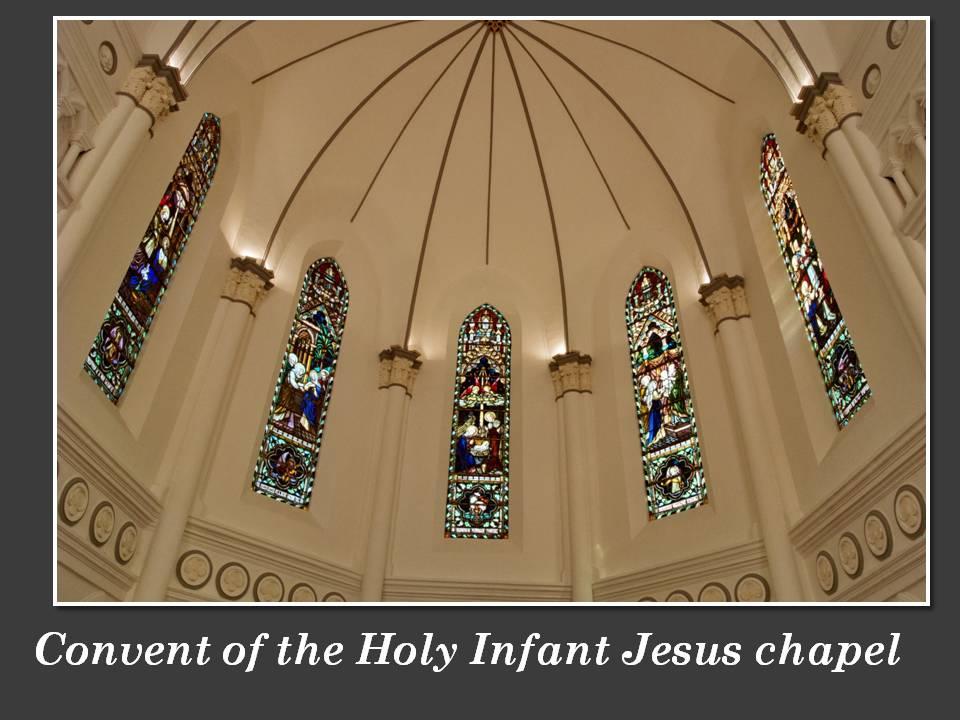
The last stop is at the former Convent of the Holy Infant Jesus chapel; now known as CHIJMES Hall This complex of convent buildings has a Gothic-style chapel. It was used as a Catholic convent for 131 years, with Caldwell House constructed in 1840–1841 and the chapel in 1904. The chapel, now a multi-purpose hall, is known as CHIJMES Hall (赞美礼堂), and Caldwell House, now an art gallery, have both been gazetted as national monuments (info from Wikipedia). The stained glass here were produced in Belgium. One of the interesting story here relates to the Gate of Hope, where at this small gate, many babies were abandoned in baskets to be picked by the Sisters of the Convent. 
Till the next time, onto the world and beyond!